
Workplace Emergency Preparedness: Statistics, Risks & Real-World Emergencies
Emergencies happen without warning. Preparedness shouldn’t.
Every year, American workplaces experience millions of injuries and illnesses, thousands of fatal occupational incidents, and medical, behavioral, and public safety emergencies that challenge organizations’ ability to respond.
Understanding these risks is the first step toward building a safer, more prepared workplace.
At First Line 360, we approach workplace emergency readiness through four professional perspectives: Emergency Medicine, Trauma, Behavioral Health, and Public Safety.
Our focus extends beyond identifying hazards. We evaluate whether organizations have the people, resources, procedures, and response systems needed to act effectively when an emergency occurs.
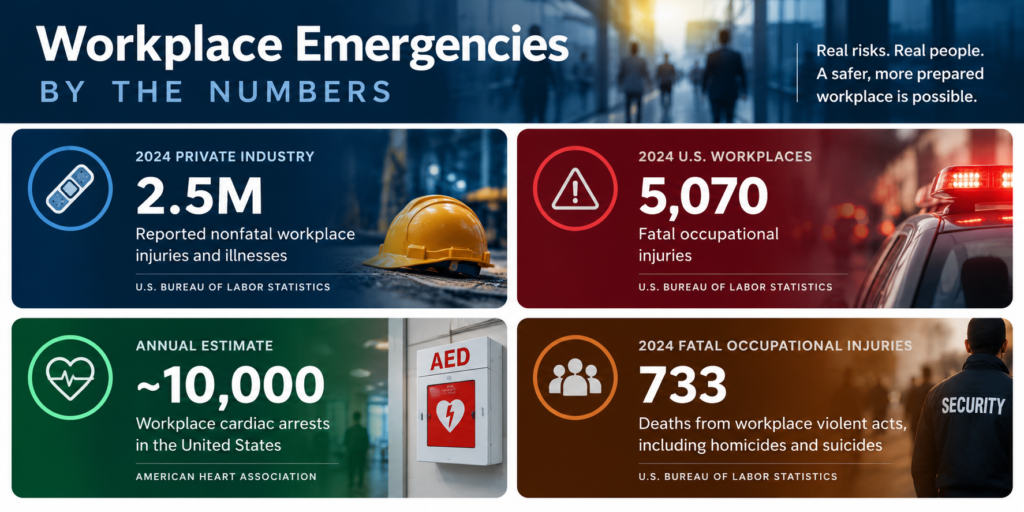
These figures represent different surveillance categories and should not be added together. They also do not capture every emergency that can occur at a workplace, particularly medical events unrelated to job duties.
4 Workplace Emergencies Every Organization Should Prepare For
Workplace emergencies vary by industry, facility, workforce, and operational environment. The following ten scenarios represent important situations organizations should consider in their emergency preparedness planning.
They are not presented as a statistically ranked list of the ten most frequent emergencies.

1. Falls and Traumatic Bleeding/Injuries
Falls can cause head injuries, spinal injuries, fractures, and other serious trauma.
Readiness considerations: Injury recognition, avoiding unsafe movement following an injury, first aid, EMS activation, and safe responder access.
Domain: Trauma

2. Sudden Medical Emergencies
Employees and visitors may experience stroke symptoms, seizures, loss of consciousness, cardiac arrest other acute medical conditions.
Readiness considerations: Recognizing warning signs, AED placement, access, knowledge of use and maintenance, CPR training, and coordinated response, activating 911, staff roles, and communicating essential information to EMS.
Domain: Emergency Medicine
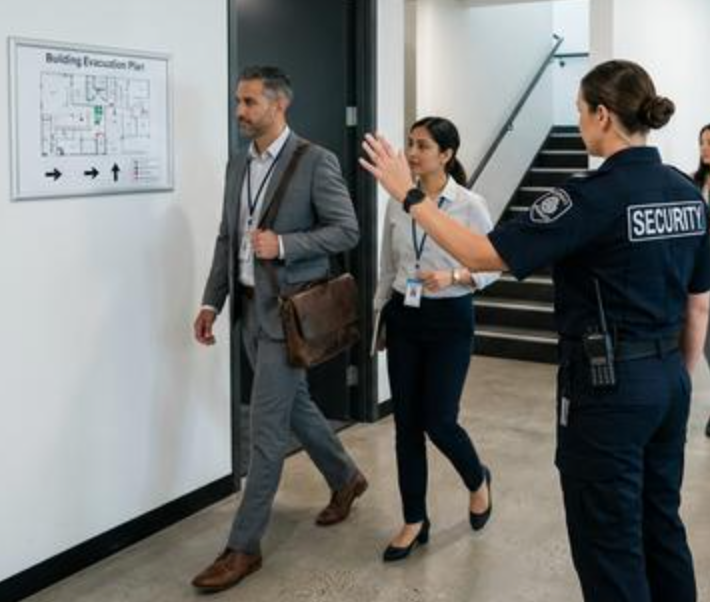
3. Workplace Violence and Security Threats
Threatening behavior, physical assaults, and other security incidents can endanger employees and visitors.
Readiness considerations: Reporting procedures, protective actions, security coordination, emergency notifications, and responder access.
Domain: Public Safety

4. Behavioral Health Crises
An employee may experience acute distress, escalating agitation, or a crisis requiring additional behavioral support.
Readiness considerations: Recognition, respectful de-escalation, immediate safety assessment, escalation procedures, and post-incident support.
Domain: Behavioral Health
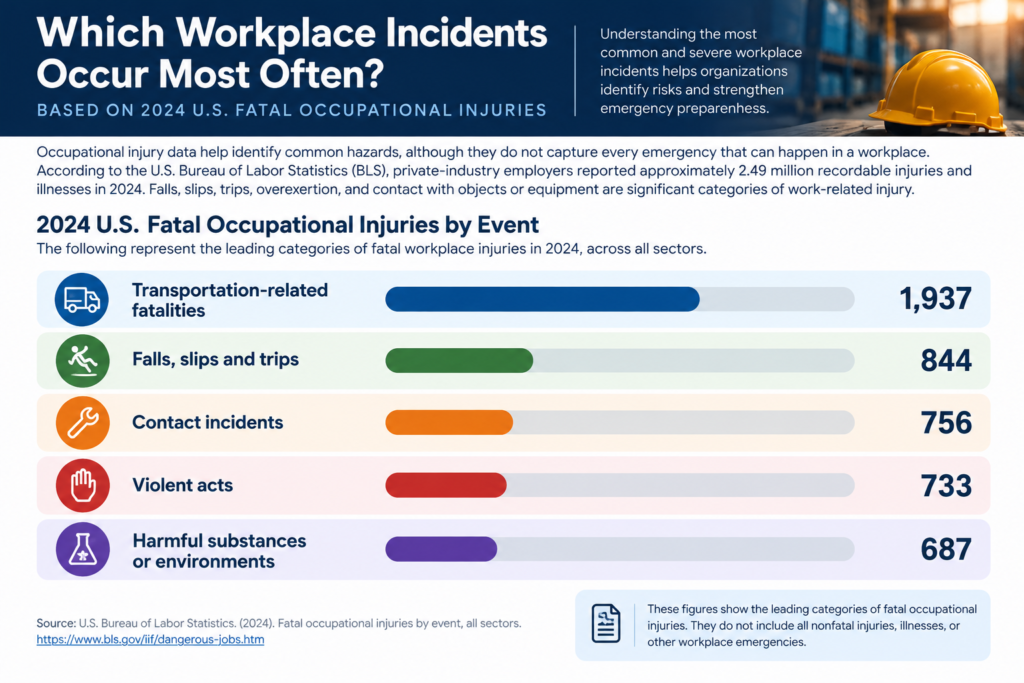
Which Workplace Incidents Occur Most Often?
The Financial Impact of Workplace Injuries
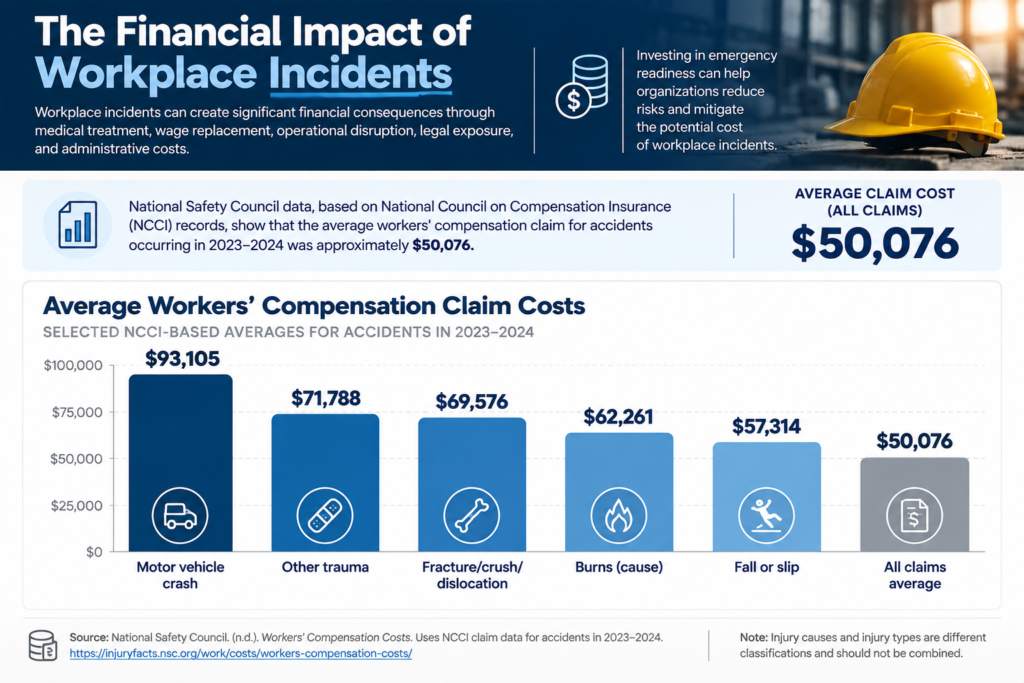
Workplace incidents can create significant financial consequences through medical treatment, wage replacement, operational disruption, legal exposure, and administrative costs.
National Safety Council data based on National Council on Compensation Insurance records show that the average workers’ compensation claim for accidents occurring in 2023–2024 was approximately $50,076.
Can Better Emergency Preparedness Reduce Insurance Claims?
Potentially. Preparedness may influence the frequency or severity of certain losses, but the effect depends on the incident, the organization’s risks, the interventions implemented, and the evidence available.
There are three ways stronger preparedness may contribute to risk management.
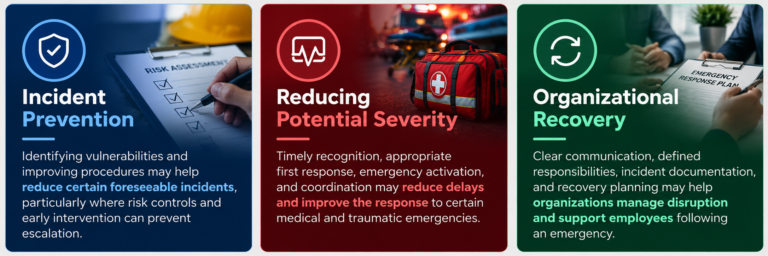
For insurers and brokers, this creates an opportunity to complement existing loss-control services with an evaluation of emergency-response capabilities.
However, improvements in preparedness should not be represented as proven reductions in insurance claims without supporting outcomes data.
Beyond the Checklist: Two Real-World Examples
Example 1 — Workplace Cardiac Arrest
An employee suddenly collapses in an office. The organization has an AED mounted on the wall, but employees are uncertain where it is located or who should retrieve it.
First Line 360 evaluates whether employees can recognize a possible cardiac arrest, activate emergency services, locate and access the AED, initiate CPR according to their training, and coordinate with arriving EMS personnel.
The American Heart Association estimates approximately 10,000 cardiac arrests occur in U.S. workplaces annually and reports that only about half of surveyed workers can locate an AED at work.
We don’t just ask: “Does your organization have an AED?”
We ask: “Would your employees know how to respond if someone experienced cardiac arrest here today?”
Example 2 — An Escalating Behavioral Crisis
An employee becomes increasingly agitated during a workplace disagreement. A supervisor is called, but coworkers are uncertain whether to intervene, seek assistance, or move to a safer location.
First Line 360 evaluates whether employees understand de-escalation principles, immediate safety considerations, reporting procedures, supervisor responsibilities, and appropriate emergency activation.
The goal is to promote a response that is safe, respectful, proportionate, and consistent with the circumstances. Agitation alone should not be treated as evidence of violence or psychiatric illness.
We don’t just ask: “Do you have a workplace violence policy?”
We ask: “Would your employees and leadership know how to respond safely if a workplace behavioral crisis escalated?”
How First Line 360 Evaluates Organizational Readiness
Our structured Emergency Readiness Assessment examines six domains:
Emergency Leadership & Planning
Medical Emergency Readiness
Trauma & Injury Readiness
Safety & Security Readiness
Behavioral Health & Crisis Readiness
Emergency Communication & Recovery
Our approach includes pre-assessment review, on-site evaluation, staff interviews, assessment of emergency procedures, policies and resources, readiness scoring, and a comprehensive report.
Organizations receive findings, identified vulnerabilities, actionable recommendations, and a prioritized corrective-action roadmap.
Is Your Organization Prepared When It Matters Most?
Emergency preparedness is more than having policies, equipment, and procedures. It requires people and systems that understand how to respond when an emergency occurs.
First Line 360 helps organizations identify vulnerabilities, evaluate readiness, and develop practical strategies for improvement.